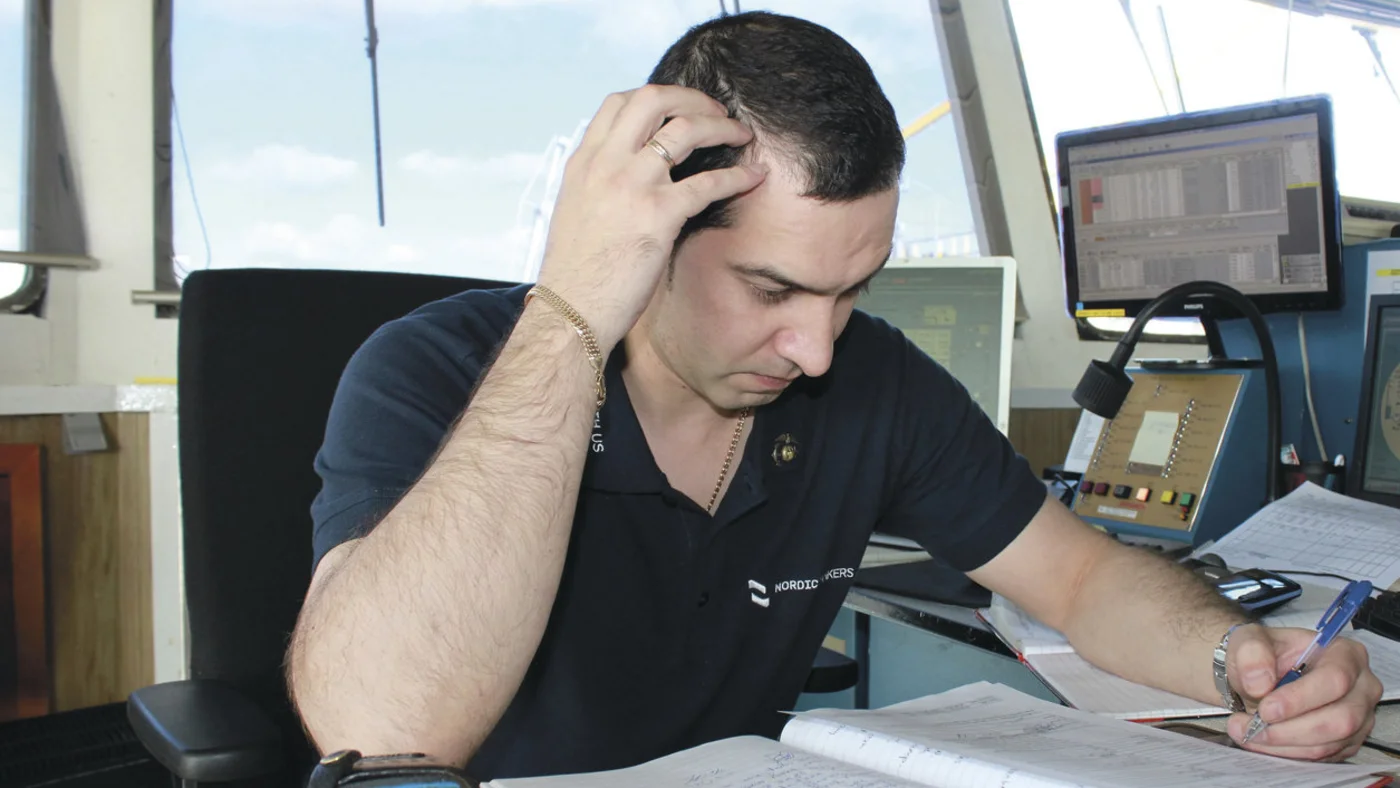
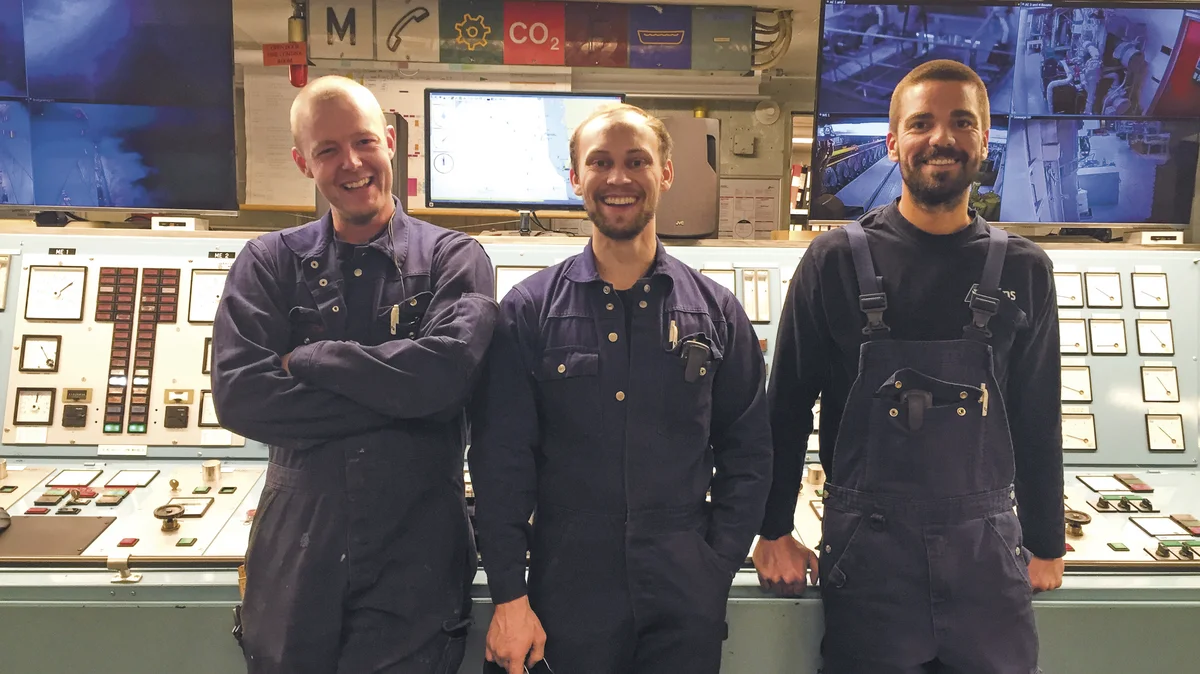
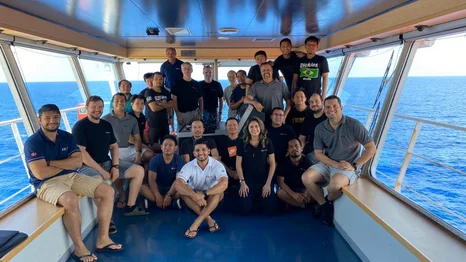
How do you make a group of merry, but weary engine room workers strong enough to cope with demanding everyday work and irregular working hours? Søren Bøge Pedersen, Senior Occupational Health and Safety Consultant, decided to answer this question when he received an enquiry from 2nd engineer, Rasmus Andersen, at the beginning of the year. “We experience issues with our sleep patterns and particularly night shifts suffer from irregular working hours and inconvenient mealtimes.” In short, “we are tired of being tired”. This is how the message ran from the workers in the engine room that, unfortunately, share on duty fatigue issues with many other seafarers.
“Being tired and fatigued at sea is a problem that can have grave repercussions for the individual seafarer, as well as the shipping companies. Seafarers fall sick or suffer from illnesses or stress due to fatigue. And a moment’s inattention caused by fatigue can have dire consequences not only for the people involved, but also for the reputation of the shipping company and its economy. That is why we always keep our attention to sleeping problems associated to fatigue, and that is also why we continuously need to come up with solutions and methods, that help people getting the sleep they need. That is a benefit to all of us,” says Søren Bøge Pedersen and continues, “nudging has become a popular tool of influencing people’s behaviour (including health improvement at the workplace) over the last few years. When employees – and the management – are highly motivated to stay alert at work, nudging can be used as an effective tool of improving work environment.”
But what is nudging anyway? And what can it be used for?
In 2012, Google conducted a health experiment in their offices in New York, since a employees had put on weight. In the experiment, M&M’s chocolate sweets were moved from transparent sweets machines to opaque bowls that had been placed behind more healthy alternatives like fruit and vegetables. Over a period of seven weeks, the 2,000 New York employees ate 3.1 billion fewer calories as a result of this experiment. (Harvard Business Review, 2016).
Kasper Hulgaard, from the company iNudgeyou, explains that a nudge is “an intervention that alters people’s behaviour without a carrot-and-stick approach. To put it differently, nudging is not about denying you the possibility of, say, eating M&M’s. It is actually about making it easier for you to avoid the temptation and/or choose a healthy alternative. For example, you can nudge people to eat more fruit through such factors as location and visual presentation.”
So, how do you nudge tired engine room workers to be sufficiently strong to manage with irregular working hours?
We are inclined to think of fatigue as mainly a lack of sleep or changeable working hours, especially night shifts. But there is much more to it than that. It is about getting quality sleep and making use of initiatives that will boost your energy, say through healthy food to help you cope with irregular working hours. A survey that was carried out among the engine room staff revealed that they were will aware of these possible initiatives. What they lacked was methods to put this knowledge to practical use. Methods that can simply modify undesirable habits and practices that are liable to interfere with sleep and eat into our energy reserves.
The employees of PEARL SEAWAYS are taken good care of. The mess offers roast, gravy and big baked potatoes, that the kitchen staff go the extra mile for. The chef tells that they strive to accommodate the wishes of as many employees as possible because “they should feel good” — those hard-working people. So, there are both good, old-fashioned, Danish dishes and a salad bar with all sorts of fresh vegetables and herbs. Warm cinnamon buns, lavish open-faced sandwiches and toasted hot dogs are served for the night shifts working in the engine room. As one of the engine room workers put it, “It is nearly impossible not to fall on the ‘goodies’, as the smell of cinnamon buns fills the air”. These less healthy treats are often enjoyed with colleagues, as it is a good way of getting together. If a problem arises and this is “something that needs to be talked through”, we will usually do that over a cup of coffee. When chief engineer, Allan Kaae Jensen, conducts regular talks with 10-12 different persons during a single shift, this will be accompanied by a good deal of coffee. And you can really have a hard time falling asleep when the shift is over.
After having visited the engine room, the bridge, the mess and the chef’s office, Kasper Hulgaard noted that there were both high- and low-hanging fruit on PEARL SEAWAYS. “Some nudges that we can put to work do not require much effort, others are more demanding. We cannot make changes in the employee shift schedule, but there is a number of easy solutions that can be effectuated on the spot.”
Kasper Hulgaard has together with SEA HEALTH & WELFARE composed several suggestions for the nudges that can easily be implemented on board. For instance, Kasper Hulgaard proposes to swap positions for mineral water and soda. The latter should still be available in the fridge, but the bottles with mineral water should be at eye level, preferably dominating the visual range (water bottles should take up more shelves than sodas). This will make people drink more water without really giving it a thought.
Moreover, caffeine free coffee should also be available in the room, for if there is no alternative to a caffeinated coffee, we will be more liable to drink what is whatever is in front of us, quickly consuming too much caffeine into our system making it hard to get a sound sleep. For most of us, drinking coffee is a matter of habit. Perhaps, we drink the first cup of coffee in order to wake up, but the rest is often consumed because it is nice or simply by habit.
You can also place a thermometer in employees’ cabins for them to make sure that the temperature is between 18 and 21 degrees, namely the best temperature for sleeping. In order to avoid big, high-calorie meals immediately before bedtime, Kasper Hulgaard suggests changing the placement of meals in the mess. Healthy meals should fill up the counter and be the first thing you see when you load your plate with food. In addition, it is a good idea to use dish signs that describe a particular dish, such as “fresh salad” or “whole-wheat bread”, and thereby helping us make a healthier choice. The healthy choices help us sleep better and be more robust to irregular working hours.
A number of conditions ought to be met for nudging to succeed. For example, there should be the desire (the preference) to change the status quo. Otherwise, you are back where you started. Kasper Hulgaard tells, “we cannot expect that everybody would want to change undesirable habits and routines. But we can help those who do want changes towards a more healthy and safe working environment. So, we can just hope that they will inspire other colleagues to follow suit.”
The biggest and most important step has already been taken the moment the engine room personnel contacted SEA HEALTH & WELFARE. “What we see here is the desire to make things better. The fact that an employee shares his frustration with fatigue at work opens up for a dialogue with those who are in the same situation. And as long as we have each other to lean on, the task will be much easier to carry out. Besides, we are experiencing a huge support from the management that allot time and resources for the nudging-against-fatigue project. This is the way it should be,” Søren Bøge Petersen from SEA HEALTH & WELFARE adds.