“One thing makes me really tired. That is to overhear an office employee say: ‘Do it because I said so’. ” Søren describes a situation he has witnessed far too many times throughout his long career in shipping. A career he began as a young mess boy. Since as first mate, and today he is the Head of Marine Standards at Ultraship. Søren speaks of the situation where an office employee receives a call from a crew member regarding a task on board. But instead of helping the crew member understand the importance of the task, it comes off as one-way communication, mostly resembling a dictatorial order. A classic example is ‘Risk Assessments’. The document that must be prepared when carrying out the estimation of potentially dangerous work situations to take necessary precautionary measures and avoid accidents. “The very minute a crew member is being told to comply with the request, simply because a person in the office demands it, we all know what happens. The task ends up as a ‘paper exercise’, where the crew member hides somewhere in a small, dark room, ticking off boxes. And that’s it ”, explains Søren and points out that this exercise doesn’t contain any safety learning whatsoever.
How did you discover problems with the communication?
“We investigated the level of implementation of safety culture on our ships. We did a survey among our seafarers and collected anonymous answers about their perception of safety. A perception that turned out to be completely different from our perception in the office. ” According to Søren, the survey revealed extensive problems with communication in many areas. It concerned communication both to and from the head office. It was found to take place during inspections and even extended to the ship’s management personnel. We discovered some ‘leading indicators’ of vaguely defined leadership throughout the whole organisation. Different messages addressing the same issue surfaced, and it was not clear at all, who required what and why. Given all the communication gaps on all levels, Søren witnessed a misunderstood form of loyalty among seafarers. It manifested itself in the aforementioned ‘paper-exercise- risk assessments’ or fiddling and avoid adhering to the regulations on rest hours. It turned out to be common practice to fill in the form with hours of rest in compliance with the rules. It looked perfectly fine on paper, but crew members kept on working. The staff assumed that they were supposed to work round the clock. As Søren explains “it soon became clear that we had to focus our attention towards the communication and the ship’s management. And the shipping company also had to direct their attention inwards. ”
What do you mean by looking inwards the company?
“If you want to practice a good safety culture on a ship, there is no other way than to make the company’s management lead the way. If there is a sincere willingness to change the way of understanding and approaching safety culture, it is important that those who communicate with ships employ a proper approach. We, the office personnel, should lead by example. No matter how skilled the seafarers might be - and often more skilled than us at the office - it is us who must act as role models. Whether it is the CEO or the supervisor. If the shipping company does not care about safety, neither will the ship. And you will have a hard time changing that. Assuming you have sent one ‘just-do-it” negative experience to a ship, a person on board will require ten positive experiences before changing the attitude towards safety. And if seafarers happened to have a negative experience every other, third or fourth time, the battle is lost. I think that is the greatest challenge we are facing in the business ”, explains Søren. But a way to stop the reckless behavior is by handing out yellow cards.
How do you practice the concept of yellow cards?It could be the example with an office employee saying ‘because I said so’. Here, we expect the colleagues to intervene and say ‘hey, that is not how we do it here’. We expect this to be normal procedure and we expect the same to happen on the ships. We once had a captain who got heavily drunk prior to a departure. The chief officer did not intervene, which was expected of him. Instead, it was the pilot. This episode was a turning point for us, and we were forced to take action. Obviously, the captain’s contract was terminated for violating the company’s alcohol policy. But we handled the case differently with the chief officer. Had we been a traditional, old-fashioned shipping company, we would have resorted to an easy solution and fired him, too. But we decided to set an example to educate other employees. We explained how he should have acted. We said, ‘you have been given a yellow card, but that’s because we believe in you’. We decided to give him a second chance and let him learn. He did, and now he is a crackerjack captain ” explains Søren.
It can be difficult to regularly practice a safety culture between office and ships. How do you close that gap?
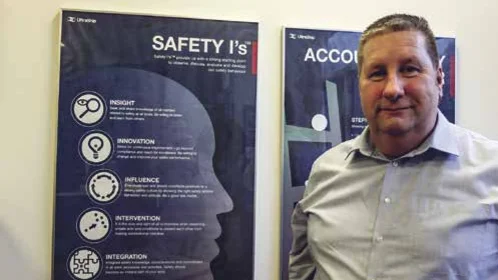
“We are trying to address this through our so-called ‘safety-ambassador-arrangement’. We launched this initiative by appointing some of the most committed officers as ambassadors to work with us here in the office. The idea behind this was to get more ‘insight’, which is one of our five Safety I’s in our Ultraship Safety Bible. At the moment, a chief officer and a chief engineer - both from the Philippines - are working here. We want to provide them with a better understanding of what kind of information the office requires to be able to give seafarers the best service. And vice versa. The plan is that the ambassadors will incorporate the safety culture and disseminate it on board our ships. ”
What would you like to obtain with the safety initiatives?
“There is a need for creating a new kind of dialogue that welcomes openness. It is possible to make changes only when we speak honestly. If I do not know that there is a problem with rest hours, I will not be able to make it right. We spend a lot of time trying to explain the seafarers that the rules that regulate hours of rest are for their sake. It is the seafarers who face a real threat by being constantly surrounded by hawsers, pumps and pistons. Not the people in the office. We try to send a clear message that nobody is pointing an accusing finger and demanding an explanation of why the rules for rest hours have not been followed. Nobody will do such a thing. It is going to be a long, tough haul. We aren’t there yet, but we are working very hard to get there. Our worst enemy is mindsets like ‘that’s how we’ve always done it, and the ships are still sailing’. We are making great efforts to change that ”, says Søren.
Cool, finally things are changing! Do you experience any changes in the communication and the way safety is understood?
“It is funny, you should ask that. This very morning, I got an e-mail from one of our captains, asking me to assist in the form of a bunker barge for his ship in Houston. In the mail, he strongly emphasised, having typed in capital letters: ‘MAKE SURE THE BUNKER BARGE WILL NOT ARRIVE AT NIGHT WHEN THE NUMBER OF PERSONNEL ON BOARD IS LOW, AND THERE IS A RISK OF VIOLATING HOURS OF REST. MAKE IT COME AT DAYTIME WHEN WE’VE GOT MOST HANDS AT OUR DISPOSAL.’ ‘That’s damn cool’, I thought. That is exactly what we have fought for. ”
Read the interview with Michael Teves, safety ambassador and First Officer from the Philippines, who was part of the Ultraship ambassador arrangement when it all started.