"You can think of nudging as a way of gently encouraging people to make the right choices. It can be the safest or healthiest choices in the context of a work environment. This can be achieved through various minor changes in the surroundings that prompt people to intuitively make the right decisions — simply because it makes sense to do so, because it is easy, because you do not have to speculate about it too much, because others do it and, finally, because you want to do it.
Nudging is clever in the sense that the method helps people to act in a way they actually want. I imagine all of us have an experience of disastrous signage in airports, where as an air traveller you are rushing around aimlessly. But we have also seen the good ones, where everything works flawlessly and where displays with boarding time and gate directions are placed correctly and show the information clearly. You can easily tell when things have been thought through and when they have not."
"Your brain is divided into two systems. System 1 includes decisions that are fast, automatic, uncontrollable, unconscious and intuitive. System 2, on the other hand, is responsible for decisions that are lengthy, deliberate, conscious and reflexive.
Research has revealed that System 1 controls ninety per cent of the decisions we make, even though we, as human beings, want to believe that we are System 2 people, who make clever, rational and thoughtful choices. But this is not the case.
In simple terms, our brain is extremely idle and we prefer to stay within System 1 in order to save energy for hard times. As human beings, we make easy choices and — if possible — take the path of least resistance.
We do not have the strength to read an IKEA-manual and would rather avoid studying detailed instructions on how to start a backup generator. But we would, however, read the manual if it were readable, short and simple.
We would not make an effort to go far to get personal protective equipment, unless it is close to our work place, and we would certainly not take the trouble reading a long and complicated manual on how to protect ourselves from the hazards posed by epoxy. On top of that, we are tired and worn out after doing long shifts or being stressed because of the workload. In the end, our brain will certainly be operating from the uncomplicated System 1. System 2 of the brain has long since been shut down.
We take the easy way out, if the instructions on the machine are
incomprehensible; and if the flow diagram to opening the bow door is hard to read, we will approach it in a way that makes sense to us at the moment — and that is not always the safe way."
"After 15 years in the shipping industry, I have seen very few instructions, work place risk assessments, signs or manuals that address System 1. On the contrary, they usually contain too much text, a kind of a hodgepodge without colours or icons to highlight essential elements. In other words, everything evens out. System 1 whispers in your ear, “You are not up to it”. While working on ships, we rarely stumble on pictures, while diagrams are designed by engineers who not necessarily have knowledge of the shipping industry.
Then why not take a picture of the backup generator and insert it into a Powerpoint? 1. Start here, 2. open here and 3. close here while you 4 etc. Imagine a ship’s assistant is being sent down to the backup generator room and he has no memory of what he learned three months ago during the extended boat and fire drill exercise. It is dark, mixed messages are blaring out of the VHF radio and some of them are directed to him. He is stressed and uses his brain capacity to the full. Send him into a dark room to follow detailed instructions on a sheet of A4 paper without pictures or diagrams. It is doomed to fail. It could similarly be a situation where an emergency fire pump or an emergency steering had to be started up. If you were a seaman, you would know that things always tend to escalate. When the accident occurs, the ship will perhaps be heaving and rolling in rough waters, and the VHF radio has not been charged up. The more stressors you add, the higher probability of people making impulsive or intuitive choices is, as the brain is just about to burst from the input. Why not paint the epoxy shelves red? Paint the epoxy PPE closet red and use a red bullet to make a reference to the PPE table. Then those who paint it will know exactly how to protect themselves. It should be easy for people to make the right choices – the safe choices. Put small labels on food containers that show the correct lifting techniques. Label the shelves with the maximum weight the items can weigh when lifted. Unfortunately, the design, build and organization of the ships are made for System 2 part of the brain. You have to think and not be complacent, you have to be rational, you have to be alert, you have to pay attention, and if something goes wrong, it is the seaman’s own fault, because he accomplished none of the above mentioned. We still read pretty often about that in accident reports. It is unfortunate that the seamen get the blame when accidents could have been avoided by using clearer instructions."
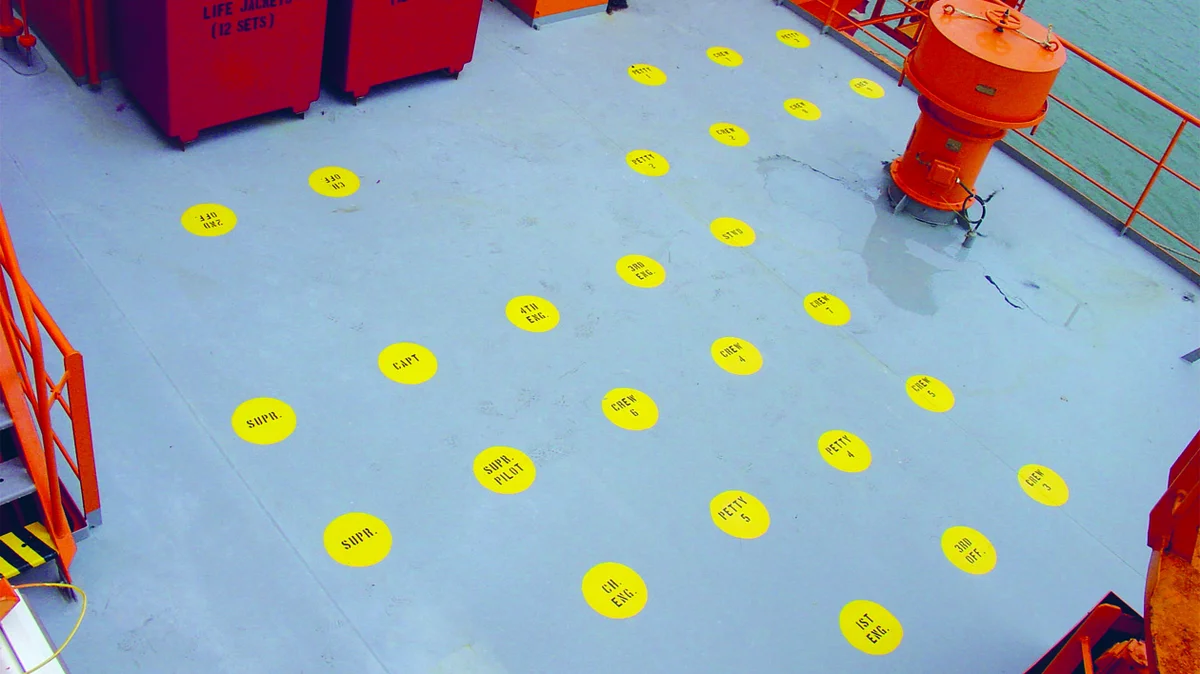
"It makes me happy when I experience that somebody has been thinking out of the box. One example is when the room numbers are written by the seats on the inside of the free fall boat, making sure that everybody knows where to sit, and the seatbelts are calibrated to fit their bodies. Small circles on the deck of the free fall boat can also make sure that the head of evacuation immediately sees if anyone is missing. To me, that is the principles of nudging used cleverly."
"It is necessary to involve people who operate with it on a daily basis. We have to ask people with hands-on experience in this industry, “When you are operating this machine, do these instructions make sense? Are you conscious about the specific danger of high pressure when you open the valve, or do you have to remember it? Can we remind you of that while you work? Is the procedure for enclosed spaces understandable? Can we tone down the complicated text and replace it with a photo, diagram or pictogram? Are we paying attention to the right issues at the right time when we are docking? Is the process in some areas hard to understand?”
Following these questions, try to simplify and clarify the daily routines in consultation with your colleagues. Set up comprehensible signs where relevant, and avoid several signs that provide the same information.
If the management wants to modify a way of behaving, it is essential for them to be specific about the desired type of behaviour. It is not enough to simply say “We have to lead healthier lives on board” or “We have to eat more fruit and vegetables”. The effect will be as expected. “Nobody takes responsibility – nobody does anything”. We will have to get down to a particular type of desired behaviour. “We wish two kilograms of carrots to be served for dinner, starting out on Wednesday evening in week 34”. Once the defined behavior is formulated, the nudging methods can begin."