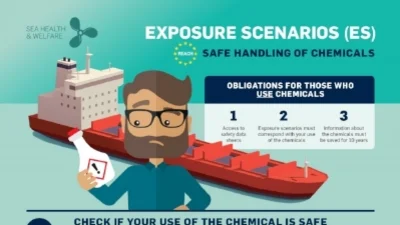
The exposure scenarios must cover all the uses that the chemical substances or the mixtures contain. Therefore, you will receive more exposure scenarios and you will have to choose the ES that describes your use. It would be a good idea if only the relevant ES is submitted to the SEA HEALTH & WELFARE chemical database. We will store the data for 10 years. You must be able to demonstrate that the exposure levels in your workplace is identical to or lower than what is described in the ES.
There may be several reasons why the supplier has not described the use you have. There may be a lack of knowledge about all the uses of the substance, but it may also be that your use cannot be supported by the supplier because it is not safe. You may then need to find an alternative and less dangerous substance.
There is a close correlation between the information provided by ES and workplace instruction. But the purposes are slightly different. In the ES, the conditions under which the work can be conducted safely must be stated. The ES must once and for all be checked either on board or by a person in the shipping company who is aware of how the work is done. The workplace instruction is supplemented with ship-related information on board. The person who performs the work receives a 2-page description on the hazards of the product (skin and/or inhalation hazard) and what diseases it can cause. In addition, the precautions to be applied are described (ventilation and PPE). The latter must of course be the same as those of the ES. The chemical section of the risk assessment contains 4 steps of which steps 1 and 2 (mapping and assessment) are covered by the information in ES, while action plans and instructions may be needed. The instruction is also for the person who performs the work. There must also be an ongoing evaluation of whether it works. In the risk assessment, there will also be other relevant risks (accidents, ergonomics, noise, etc.).
Today we have the following products with ES in the chemicals Database. Please check if one or more of these products are available on the shipping company’s positive list or if you use it on board. If yes, check if your application has been described by the supplier, and if you thereby have a safe use.